Methodology §3

Two paired field protocols · One mid-project loop

NECx living-workplace narrative collection (Protocol A) · CNAM + NMS historical-archival reconstruction (Protocol B). A mid-project loop feeds Round-1 findings into Fieldwork 2.

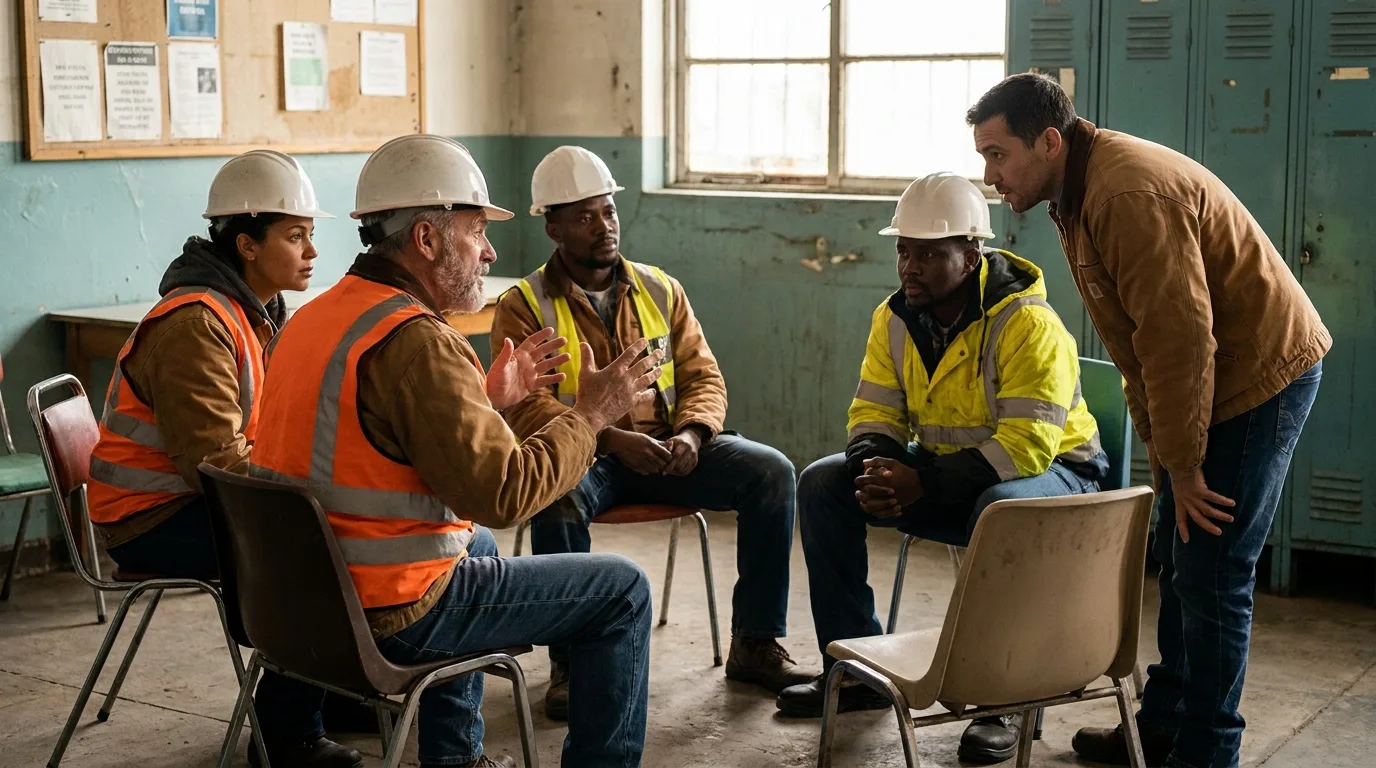
Layered field-research materials: notebooks, narrative diagrams and archival worker photographs
A

Narrative collection

NECx workshops in living workplaces

  1. Convene workers, vocational trainers, community representatives at energy-transition workplaces.
  2. Narrative structure analysis: score narrative dimensions (protagonists, temporal progression, closure) drawn from computational narrative science. Two classes: research narratives (work-life experience) and narratives of transitions (sectoral/ecological change).
  3. Map evidence on spatio-temporal and causal-relational grids using STS-informed diagramming for mechanism visualization. Three narrative scales — micro-narrative · story · saga cycle.
  4. Detect scripts and narrative performance — e.g. 'redundancy → retraining → green job' — showing how workers narrate policy transitions through lived experience.
  5. Test narrative inference against qualitative rigor standards (internal consistency · coherence · adequacy to evidence) using Narrative Science epistemology.
B

Historical-archival fieldwork

CNAM + NMS collections as long-time-scale observation

  1. Archives as longitudinal observation series across multi-decade transition windows — technological, workplace, and community shifts.
  2. Reconstruct prior industrial transitions from CNAM Musée des Arts et Métiers collections: assistive technology, workplace accommodation, energy-system changes.
  3. Museum-anchored method: Yugoslav and Slovenian industrial heritage collections documenting how transitions reshape workplace communities.
  4. Arrange archival materials into narrative form following Protocol A structure — enabling cross-temporal competence comparison.
  5. Trace lineage of policy discourses and counter-narratives — showing how official language about transitions maps (or not) onto worker experience.

Two fieldwork rounds, one mid-project synthesis

  1. Step 01 · Apparatus

    Narrative Science framing applies to every account.

  2. Step 02 · Fieldwork 1

    M9–M22. Protocols A and B in tandem across anchor regions (FR · SE · SI · LV · BE · UK · IT · MN · PL).

  3. Step 03 · MSM synthesis

    M22–M28. The Multi-Stakeholders Meeting (MSM) and Science Meets Politics (SMP) Conference (M27) synthesise Fieldwork 1 with civil servants, social partners and European elected officials from all political families. Interim analytics consolidation (M28) calibrates Round-2 instruments.

  4. Step 04 · Fieldwork 2

    M28–M40. Round 2 (UA · RS · ME · KE + COPs) applies MSM and interim-analytics feedback, recalibrated against first-round competence statements.

  5. Step 05 · Operationalisation

    M40–M48. Five output streams — Atlas, SED-PAN, OSDEM, Roadmap, replication modules. Expo-Action opens M40 for an 8-month public life.

  6. Step 06 · Open science

    Throughout. Preprints and open peer review; narrative and archival datasets to CESSDA / EOSC under FAIR principles.

Citation backbone

  • 01

    Hajek, K.M. (2022)

    Narrative-identification protocol · Ryan's fuzzy-set narrativity · research vs nature narratives · Cambridge UP ch. 2

  • 02

    Berry, D.J. (2022)

    Narrative positioning · genres + counter-genres · ch. 16 of the Narrative Science anthology — applies to policy-discourse analysis

  • 03

    Paskins, M. (2022)

    Breakdown narratives · case-typology for failure / disruption documentation — fits transition-disruption pattern detection

  • 04

    Wise, M.N. (2017 / 2022)

    'Cat's cradle' diagrams · relational visualisation for opaque causal mechanisms — physics-history origin, applied here to socio-technical complexity

  • 05

    Crasnow, S. (2017 / 2022, ch. 11)

    Process tracing & causal-claim defence — translates narrative inference into language policy reviewers expect

  • 06

    Morgan, M.S. (2022)

    Narrative as 'general-purpose technology' for science · the three quality criteria (consistency / coherence / adequacy) · ch. 1 Cambridge UP — the umbrella reference

  • 07

    Lynall, G. (2022)

    Solar-narrative case studies — direct energy-sector precedent for narrative-evidence on green transitions

  • 08

    Sleigh, C. (2022)

    Carbon-economy decline narratives — direct precedent on energy-decline cases (relevant for Velenje coal phase-out anchor)

  • 09

    Helgeson, J., Glynn, P. & Chabay, I. (2022)

    Narratives of sustainability in digital media — DONS observatory · *Futures* 142, 103016 — direct conceptual precedent for OSDEM

  • 10

    Moezzi, M., Janda, K.B. & Rotmann, S. (2017)

    Using stories, narratives, and storytelling in energy and climate change research · *Energy Research & Social Science* 31 — methodological flagship for energy-sector narrative evidence

  • 11

    Koch, L., Gorris, P. & Pahl-Wostl, C. (2021)

    Narratives, narrations and social structure in environmental governance · *Global Environmental Change* 69, 102317 — bridges narrative evidence to policy-translation

  • 12

    Towers, S., Kajitani, Y., Chabay, I. & Okada, N. (2022)

    Narratives, energy policy, and disasters: power grid failures Hokkaido + Texas · *Energy Research & Social Science* — direct energy-disruption case methodology

  • 13

    Suchman, L. (2007)

    Human-Machine Reconfigurations · Cambridge UP — situated-action framework for worker-machine interaction (cited by Paskins, foundational for AI-mediation analysis)

  • 14

    Brynjolfsson, E., Li, D. & Raymond, L. (2023)

    Generative AI at Work · NBER WP 31161 — empirical LLM-in-workplace productivity effects

  • 15

    Crawford, K. (2021)

    *Atlas of AI: Power, Politics, and the Planetary Costs of AI* · Yale UP — energy + labour + extractive geography of AI; critical for the green-digital tensions

  • 16

    Bender, E.M., Gebru, T., McMillan-Major, A. & Shmitchell, S. (2021)

    On the Dangers of Stochastic Parrots · FAccT 2021 — whose-narratives-get-encoded critique

  • 17

    Strubell, E., Ganesh, A. & McCallum, A. (2019)

    Energy and Policy Considerations for Deep Learning in NLP · ACL 2019 — AI's own energy footprint

  • 18

    JRC (2022)

    Towards a green & digital future: Key requirements for successful twin transitions in the EU · Joint Research Centre — EU-policy anchor for SED-PAN Digital-Green Competence Matrix

  • 19

    Cedefop (2023)

    Skills in transition: The way to 2035 — green-digital competence pair-maps · EU agency anchor for OSDEM

  • 20

    Cedefop ESJS2 (2023)

    Second European Skills and Jobs Survey · flagship EU dataset on internal skill gaps, training, mismatch — anchor for SED-PAN's quantitative spine alongside the GreenPulse narrative arm

  • 21

    SkillsPULSE D2.1 (2024)

    Conceptualisations of skill shortages and skill gaps · mismatch-taxonomy foundation (external shortages · internal gaps · over-skilling) imported into SED-PAN

  • 22

    SkillsPULSE D2.2 (2024)

    Empirical investigation of skill gaps in Europe · vacancy-NLP + ESJS2 cross-analysis · quantitative spine reusable for SED-PAN — channel via Università di Pisa internal anchor

  • 23

    Lightcast (2024)

    Online job-vacancy NLP corpus · multi-country AI-skill demand + occupational mix + wage signals · reuse channel via SkillsPULSE (Pisa)

  • 24

    OSKA (Estonia)

    National sectoral-skills foresight system · qualitative + quantitative blend · methodological comparator for OSDEM observatory format

  • 25

    UK Unit for Future Skills

    Composite occupational-demand dashboards integrating visa data + job ads + wage changes · input model for the Digital-Green Competence Matrix