Layer 04 · Operational outputs

What leaves the project

The field protocols feed a five-stream output suite: knowledge artefacts that consolidate evidence, instruments that turn it into policy-grade signal, replication modules that carry it into workplaces, classrooms and publics.

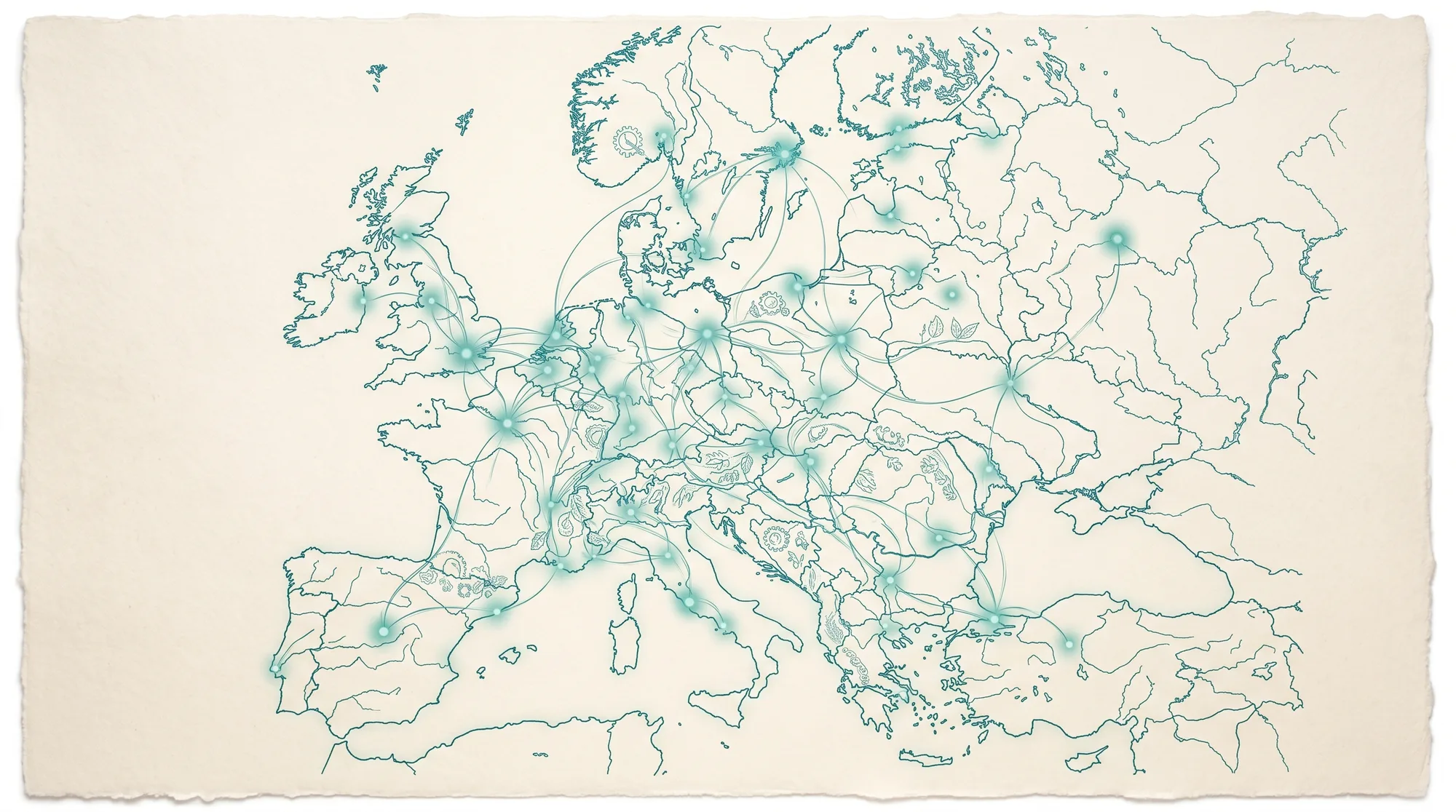
Europe rendered as teal line-work with glowing nodes connected by flowing knowledge networks
Atlas of Transitions — competence evidence, mapped where it is produced

How we engage GreenComp

GreenComp as the operational target framework

GreenComp is the JRC's European sustainability-competence framework (12 competences, 4 areas). The TRANSFO-07 call expects explicit engagement. GreenPulse delivers it four ways:

As target

Every Atlascompetence statement maps to one of GreenComp's 12 competences — cross-reference table per anchor region.

As benchmark

OSDEM measures "GreenComp travel": do workers narratively recognise the conduct GreenComp describes as their own?

As policy anchor

The Policy Integration Roadmap recommends GreenComp-aligned VET-curriculum edits per anchor region. Concrete, dated, costed.

As pedagogical backbone

Green Transition Academies use GreenComp areas as syllabus structure. GRBC measures gendered + ability access gaps relative to GreenComp benchmarks.

Competence-identification artefacts

Atlas of Transitions

KER1

Atlas of Transitions — energy-sector skill atlas

A skill atlas built where Cedefop / ESCO / Eurostat data thins out: the meso-level of sectors, regions and workplaces. Three layers: (1) EU strategy targets (Union of Skills · Pact for Skills · GreenComp) per anchor region; (2) competence-in-use evidence from NECx workshops and CNAM archival reconstruction (NMS contribution under WP-design scoping); (3) the gaps the comparison reveals. T-shaped competence model built in: deep functional expertise (vertical) × transversal · digital · interpersonal skills (horizontal). Each statement cross-references SkillsPULSE's mismatch taxonomy (external shortage / internal gap / over-skilling) so the Atlas reads in both EU-quantitative and narrative registers. Articulates upward into Eurostat / Eurofound classifications, downward into VET curricula. Built for reuse by ministries, regional agencies and EGDC-cluster projects.

OSDEM

KER2

Observatory for Skills Dynamics & Equity Metrics

The quantitative arm. A sector-level observatory translating narrative-validated competence indicators into ESS / Eurofound-aligned series — an EU instantiation of the DONS digital observatory (Helgeson, Glynn & Chabay 2022, *Futures*), aligned with Cedefop and JRC twin-transition anchors. Disaggregates by gender AND disability AND life-course stage.

Captures human-agent narratives. As LLM copilots mediate work, OSDEM logs human-agent dialogue — what workers ask their tools, what the tools answer — as competence evidence. Consent-based under the project DPIA, auditable by social partners.

SED-PAN

KER3

SED-PAN Dataset & Prototypes — Sectoral · Ecological · Digital × Policies-Archives-Narratives

Open dataset family pairing sectoral, ecological and digital indicators with policy texts, archival traces and narratives. Houses the Digital-Green Competence Matrix — twin-transition pair-maps (grid-data literacy ↔ renewables · AI-fluency ↔ industrial energy · prompt-craft ↔ vocational tooling) aligned with the JRC twin-transitions report and Cedefop's *Skills in transition*. Three-layer mismatch taxonomy imported from SkillsPULSE (D2.1): external skill shortages · internal skill gaps · over-skilling — applied to the energy sector through the consortium's Pisa-SkillsPULSE channel. A quantitative spine (University of Warsaw Faculty of Economic Sciences · ESJS2 + Lightcast vacancy-NLP reuse) extends SED-PAN into Green Deal pathway analysis, clean-energy transition pace and socioeconomic-resilience indicators. Booster-skills axis — AI literacy, prompt engineering, transversal cognitive skills — sits alongside green technical competence in every pair-map. An AI-energy-cost sub-dataset documents the contradictions of AI-for-sustainability. Released as immersive exhibits in museums and innovation hubs, replicable across Member States.

Translation to policy

Policy Integration Roadmap & Messaging Toolkit

KER4

Policy Integration Roadmap & Multistakeholders Messaging Toolkit

Policy-ready competence-pathway briefs per anchor region, calendared to EU and national policy windows, submitted to DG CLIMA, DG EMPL and DG RTD — backed by formal policy assessment + impact evaluation (University of Warsaw). The paired Messaging Toolkit lets civil servants, social partners and unions reuse the evidence in their own institutions — GreenComp on the ground. Delivery runs through the Multi-Stakeholders Meeting + Science Meets Politics Conference (M22–M28), with ENOP's political-foundation network carrying findings into member-state policy circles.

Replication modules — inclusive competence acquisition

GRBC

KER5

Gender & Reverse-Bias Competence Bootcamps

Workplace modules that surface and reshape gendered + ability-based bias in green-jobs hiring and competence acquisition. Pairs the existing gender track (Madagascar PoC) with a disability-inclusion track co-designed with European Disability Forum or Inclusion Europe partners. Directly answers the call mandate on gender + disability.

Green Transition Academies

KER5

Green Transition Academies

Short-format vocational academies in the anchor regions. Adult-worker tracks in Norrbotten, Grand Est and Velenje, co-designed with VET providers to turn Atlas / SED-PAN evidence into competence-pathways. A dedicated 15–19 yo youth track runs in Montenegro via the ZOCG youth network — answering the call's age-of-intervention question. One pilot is shaped to be New-European-Bauhaus-compatible (see Expo-Action).

Expo-Action

KER5

Expo-Action — public exhibitions aligned with the New European Bauhaus

Public exhibition format leveraging the Musée des Arts et Métiers (CNAM) and partner-museum publics (NMS, anchor-region museums). The New European Bauhaus (NEB) Facility funds work meeting its three values — beautiful, sustainable, together. Expo-Action meets all three by construction: museum-grade design, sustainability-themed content, accessibility-first curation. Designed to co-cluster with NEB Facility projects on dissemination.

Open data — long-term reuse

FAIR Dataset on EOSC

KER6

FAIR Dataset — full project corpus deposited on EOSC

The full GreenPulse evidence corpus — narratives, archival reconstructions, SED-PAN datasets, OSDEM series, codebooks — deposited on the European Open Science Cloud (EOSC) under FAIR principles (Findable · Accessible · Interoperable · Reusable), with permanent PIDs/DOIs. All six KERs stay available beyond the project lifetime. Integrated with CESSDA for long-term access to narrative material.